
There is no single "best" cartridge among spun (melt-blown), pleated, and string-wound filters.
The Basics
Sediment filters are designed to remove suspended particles from water, such as sand, silt, dirt, rust and other particulate matter. As water passes through the filter, these particles become trapped within or on the surface of the filter media, depending on the cartridge construction.
Standard sediment filters do not remove dissolved contaminants, such as dissolved chemicals, minerals or heavy metals, and are not designed to improve water taste or odor. Before selecting a sediment filter, it is important to identify the water quality issue to determine whether sediment filtration is the appropriate treatment.
The main differences between spun polypropylene, pleated polyester and string wound cartridges are how the filter media is constructed and how sediment is captured. Each type offers different filtration characteristics, dirt-holding capacities and application benefits.
Point-of-Entry (POE) Filtration
Sediment filters are commonly installed as Point-of-Entry (POE) filtration systems, also known as whole-house filtration. These systems are installed where water enters a home or building, allowing incoming water to be filtered before it reaches plumbing fixtures, appliances and other water treatment equipment.
Although POE sediment filtration is often associated with private well water systems, municipal water can also contain sediment. Particles such as sand, silt, grit, rust and scale can enter the water supply or break away from distribution pipes and plumbing lines.
Excess sediment can contribute to wear, clogging and maintenance issues in downstream equipment, including water softeners, iron filters, water treatment systems, toilet fill valves, faucets, washing machines, dishwashers, water dispensers and ice makers.
Installing a properly sized sediment pre-filter at the point of entry can help reduce the amount of particulate matter reaching this equipment, potentially extending it’s service life and reducing maintenance requirements. This can be particularly beneficial for protecting water softeners and other water treatment equipment from excessive sediment buildup.
Regardless of whether your water comes from a private well or municipal supply, testing your water and evaluating your filtration needs can help determine whether a POE sediment filtration system is a suitable addition to your plumbing system.
Types of Sediment Filter Cartridges
Boshart offers three common types of sediment filter cartridges: spun polypropylene, pleated polyester, and string wound. All three are designed to capture suspended particles, but their construction affects how they filter water, how much sediment they can hold and how they perform in different applications.
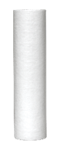 Spun polypropylene: Manufactured using a melt-blown process that creates multiple layers of polypropylene fibers. Their gradient-density construction allows sediment to be captured throughout the depth of the cartridge, with larger particles generally being trapped closer to the outside and finer particles captured deeper within the media.
This depth-filtration design provides good dirt-holding capacity while helping maintain flow and minimize initial pressure drop. Spun polypropylene cartridges are commonly used in residential, commercial and industrial filtration applications, including as pre-filters for reverse osmosis systems and other water treatment equipment.
Boshart’s spun polypropylene cartridges are manufactured from high-purity polypropylene without adhesives, binders or surfactants.
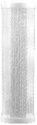 Pleated Polyester: Made from non-woven polyester filter media folded into pleats around a polypropylene support core. The pleated (accordion fold) design provides a larger filtration surface area, allowing the cartridge to hold more sediment while maintaining good flow rates and reducing initial pressure drop.
Unlike depth-style cartridges, pleated filters primarily capture sediment on the surface of the filter media. Many pleated cartridges can be cleaned and reused, making them a practical option for applications where cartridge maintenance and reuse are desirable. Boshart’s pleated polyester cartridges are suitable for residential, commercial and industrial applications.
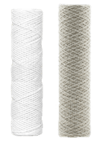 String Wound: Manufactured by winding fibers diagonally around a central core, creating a layered depth-filtration structure that captures sediment throughout the cartridge. Boshart offers polypropylene, bleached cotton and natural cotton media, each with different core materials and temperature ratings. Polypropylene is suitable for standard-temperature applications, while both cotton versions are rated up to 300°F (149°C). Available in various micron ratings, string wound cartridges are ideal for water with heavy or unpredictable sediment loads, offering high dirt-holding capacity and gradual pressure drop before clogging.
Micron Rating
When selecting a sediment filter cartridge, two factors should be considered: the micron rating and whether the rating is nominal or absolute.
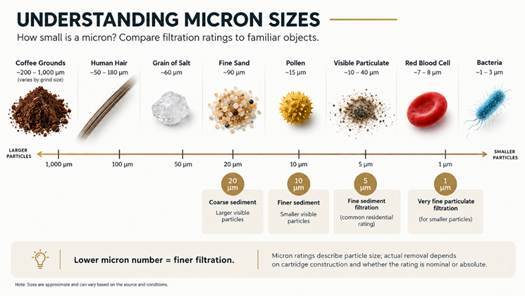
A micron (µm) is a unit of measurement equal to one-millionth of a meter. The micron rating indicates the approximate particle size a filter is designed to capture.
A lower micron rating captures finer particles, while a higher micron rating is generally intended for larger sediment particles. For example, a 1- micron filter captures finer particles than a 10- or 50- micron filter.
Nominal vs. Absolute Rating: The nominal or absolute rating indicates the filter’s particle removal efficiency at it’s stated micron rating.
- A nominal rating indicates that the filter captures a specified percentage of particles at or above it’s rated micron size. The removal efficiency can vary depending on the manufacturer and filter construction.
- An absolute rating indicates a much higher level of particle removal efficiency, typically 99.9% at the stated micron size, depending on the manufacturer’s testing criteria.
The appropriate micron rating depends on the type and size of sediment present in the water and the desired level of filtration. Selecting a filter with too fine a micron rating can cause it to clog more quickly, restrict water flow and increase pressure drop.
A water test and consideration of the system’s flow requirements can help determine the most suitable micron rating. When unsure, starting with a 10- micron cartridge may be a practical approach, adjusting to a finer or coarser rating based on filtration results and how quickly the cartridge becomes clogged.
|
Micron Rating |
Filtration Capability |
|
50 Micron |
Captures visible sand, coarse dirt, rust flakes and heavy scale |
|
20/25 Micron |
Captures finer grit and visible suspended debris while maintaining high water flow and a longer filter lifespan |
|
10 Micron |
A popular choice for whole house filtration. Removes fine silt, cloudiness, sand, rust and dirt while helping to maintain good water pressure |
|
5 Micron |
A common choice for general sediment filtration, often considered the gold standard, balancing improved water clarity with reliable water flow. Captures fine silt, sand, rust and dirt that may pass through a 10 micron filter. |
|
1 Micron |
Captures very fine suspended particles, including microscopic silt and clay. Ideal for applications requiring high water clarity, such as dedicated drinking water taps or as a final sediment filtration stage before UV or RO systems. |
The human eye can typically distinguish individual, isolated objects down to approximately 40-50 microns in size under ideal conditions. This means particles smaller than approximately 50 microns may not be individually visible to the naked eye, although they can still contribute to water cloudiness or discoloration.
Cartridge Sizing
Cartridge size plays an important role in sediment filtration performance. The cartridge’s diameter and length affect its available filtration surface area, dirt-holding capacity and flow capabilities.
Generally, larger cartridges provide greater filtration capacity and can accommodate higher flow rates than smaller cartridges. For example, a 20” long cartridge will have double the flow capacity of a 10”. It also doubles the sediment holding capacity and the time it will take for them to become plugged. This extends service life and reduces the frequency of cartridge replacements.
For whole-house and Point-of-Entry (POE) applications, cartridge size should be considered in relation to the building’s peak water demand and expected sediment load. A cartridge that is too small for the application may become plugged more quickly, resulting in increased pressure drop, reduced water flow and more frequent replacements.
Boshart offers sediment filter cartridges in the following nominal sizes:
- Standard: 2-1/2” and 2-3/4” outside diameter
- Giant: 4-1/2” outside diameter
- Nominal Lengths: 5”, 10” & 20”
For additional guidance on determining the appropriate cartridge size and flow capacity, refer to our What are the required steps to properly select a water filter article.