
Understanding How Water Filtration Works
Water filtration is the process of removing unwanted particulate and undesirable taste and odors. It is important to understand that traditional water filters are not water treatment systems. You must always get your water properly tested before determining which filtration system to use.
WARNING: Do not use with water that is microbiologically unsafe or of unknown quality without adequate disinfection before or after the filter. Traditional filters improve appearance, taste, and odor—but they do not make unsafe water safe.
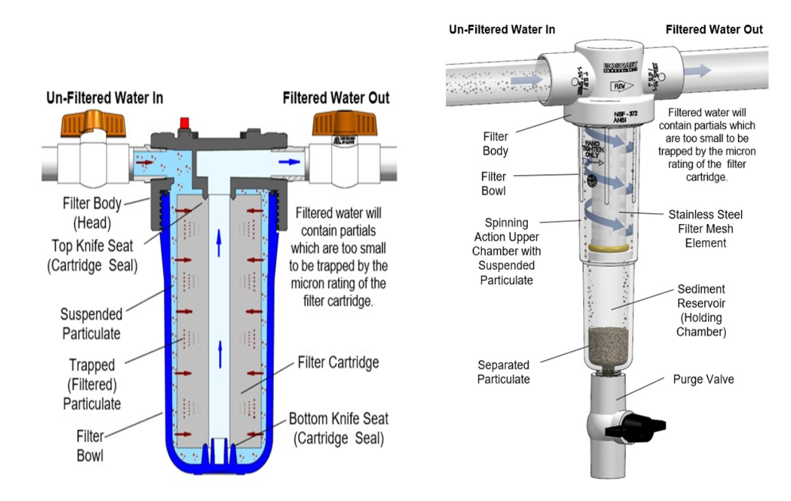
Filtration systems typically remove:
- Sediment (sand, silt, dirt, scale, rust)
- Undesirable taste and odor
- Certain nuisance compounds such as Radon and Volatile Organic Compounds (VOCs)
Part 1: How to Properly Select a Water Filter
Selecting a water filter correctly is critical. The most common mistake is choosing a filter housing first and then trying to fit a cartridge into it. This often leads to:
- Insufficient flow capacity
- Reduced cartridge lifespan and frequent cartridge changes
- Higher overall filtration costs
When it comes to traditional sediment filter housings and cartridges, it is better to err on the side of too large than too small. Here are the Five Required Steps:
Step 1 – Have Your Water Tested
Before selecting any filtration system:
- Ensure your water is microbiologically safe for drinking and cooking
- Identify specific water quality issues
- Determine particulate size
Testing helps determine what type of cartridge is required and ensures proper system sizing.
Step 2 – Determine the Type of Filter Cartridge Required
The type of cartridge needed depends on the specific water issue:
► Sediment / Appearance Issues
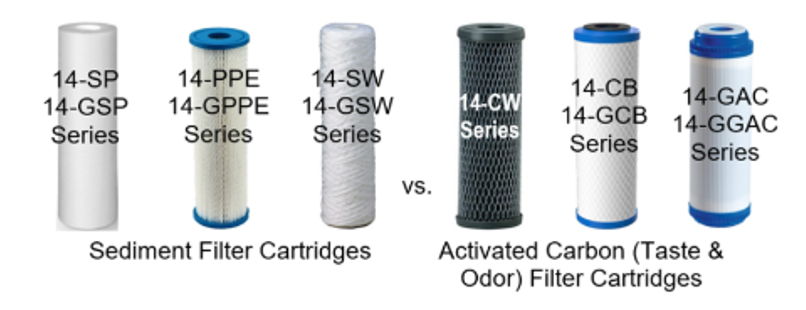
Use Sediment cartridges such as:
- Spun Polypropylene (SP)
- Pleated Polyester (PPE)
- String Wound (SWP, SWBC)
► Taste Issues
Use Activated Carbon cartridges:
- Carbon Block (CB)
- Granular Activated Carbon (GAC)
- Carbon Wrap (CW)
► Odor Issues
Also use Activated Carbon cartridges (CB, GAC, CW).
Activated carbon cartridges are commonly used in Point-of-Use (POU) systems but may also be used in Point-of-Entry (POE) systems for nuisance compounds such as Radon and VOCs. VOCs can vaporize during showers, washing, and dishwashing and come into contact with skin.
Step 3 – Verify the Desired Flow Rate (GPM)
Desired Flow Rate is the volume of water in gallons per minute (GPM) that you want to have available when multiple faucets or appliances are in use. To determine the flow requirement needed for your filter, rather than basing this need on the gallons per day usage of your home, you would need to calculate your peak flow demand in gallons per minute (GPM). Below is a guide on the GPM range of common appliances and fixtures.
Typical Fixture GPM Ranges:
- Dishwasher: 2–3 GPM
- Washing Machine: 4–5 GPM
- Bathtub: 3–8 GPM
- Shower: 2–5 GPM
- Faucet: 2–3 GPM
- Toilet: 2.5–5 GPM
Consider:
- Simultaneous appliance use
- Lawn/garden watering
- Future renovations (additional bathrooms, laundry)
Step 4 – Select Cartridge Size
Choose a cartridge with a flow capacity significantly higher than your required GPM.
Rule of Thumb:
- Minimum: 1.5× desired flow, Light sediment load: 1.5× may suffice
- Recommended: 2x desired flow
- Heavy sediment load: up to 3x desired flow
Why Oversize?
Published flow rates are based on clean cartridges. As sediment accumulates:
- Pressure drops
- Flow decreases
If you select a filter cartridge at the minimum desired flow rate, the cartridge will quickly fall below acceptable performance and require premature replacement resulting in increased filtration costs.
Ideally, cartridges should last 4–6 months, with changeout at six months to prevent bacterial buildup.
Cartridge Size Options
Outside Diameter:
- Standard: 2½"–2¾"
- Giant: 4½"
Length (available in both Standard and Giant size Outside Diameter):
- 10" Nominal
- 20" Double Length
Notes:
- Overlap may exist between 20" Standard and 10" Giant options.
- Flow restriction is typically caused by piping and filters—not municipal supply.
- Upgrading housing size can resolve flow limitations.
Step 5 – Select the Filter Housing (Last Step)
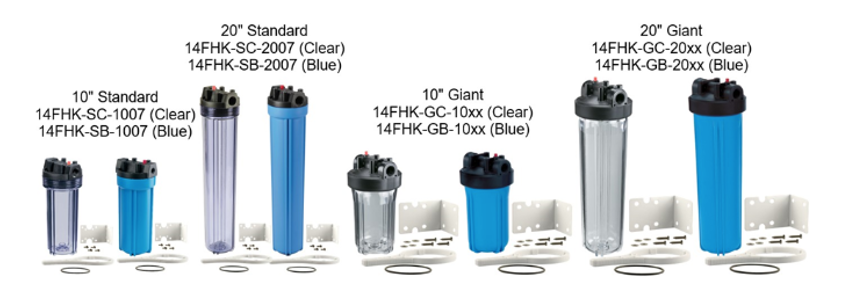
The housing must accommodate the correctly sized cartridge.
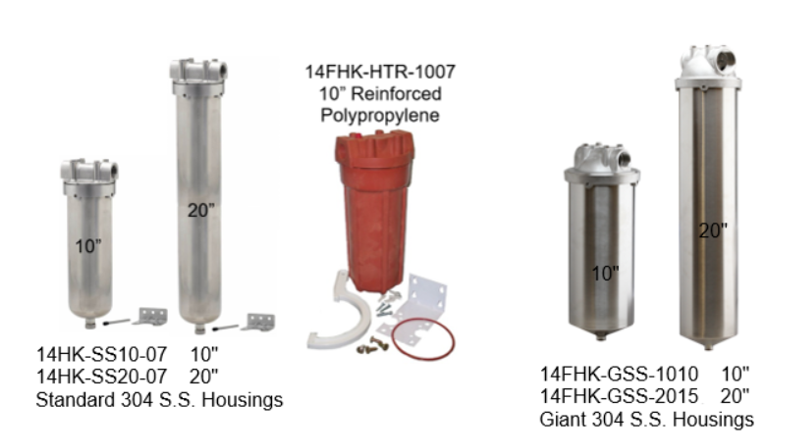
Housing Types:
- Slim Line
- Standard
- Valve-In-Head (VIH)
- Giant
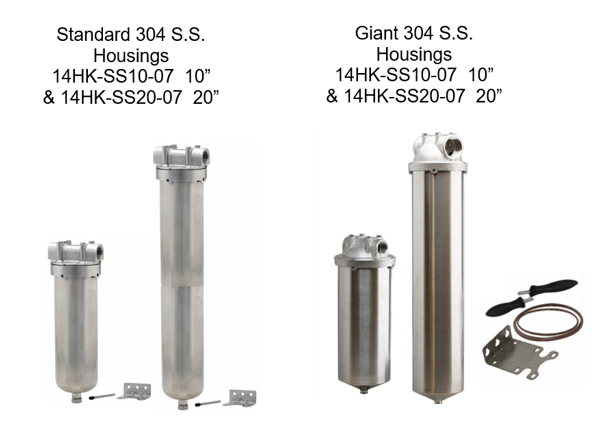
- Stainless Steel
- High Temperature
Material Options:
- Polypropylene
- Polypropylene / Styrene-Acrylonitrile
- Polypropylene / Styrene-Acrylonitrile with Stainless Steel Thread Inserts
- Stainless Steel
- Glass-Reinforced Nylon (High-Temp)
Bowl Options:
- Clear (5-year lifespan) must not be used indirect sunlight
- Blue (10-year lifespan) suitable for use where there is UV exposure
- Red (High-Temp) suitable for use where there is UV exposure
- Stainless Steel (High-Temp, High Pressure) suitable for use where there is UV exposure
Other than the filter bowl lifespan, temperature rating, and UV limitations, the choice between blue and clear filter bowls often come down to customer preference. Some customers like to see what is going on inside their filter bowl, other customers prefer not too.
Giant housings offer multiple inlet/outlet connection sizes.
To help decide between these, consider Flow Velocity. It is recommended to size piping to maintain a water velocity of 5 ft/second (1.524 LPM). Five feet per second is a threshold that is widely accepted by engineers and designers because beyond this velocity, the friction losses, danger of water hammer, and pipe movement due to water momentum changes are deemed to be too high.
- 3/4” connections should be limited to 7 GPM
- 1” connections should be limited to 12 GPM
- 1-1/2” connections should be limited to 27.5 GPM
When higher flow capacity is required, it may be necessary to install 2 filter housings in parallel.
Part 2: Categories of Filtration Systems
Filtration products fall into four categories.
1. Point-of-Entry (POE) – Whole House Filtration
POE systems are installed where water enters the home and filter every drop before it reaches appliances (such as iron filters and water softeners) and fixtures.
Typical Use:
- Sediment removal to protect appliances:
- Water heaters
- Boilers
- Iron filters
- Water softeners
- Plumbing Fixtures
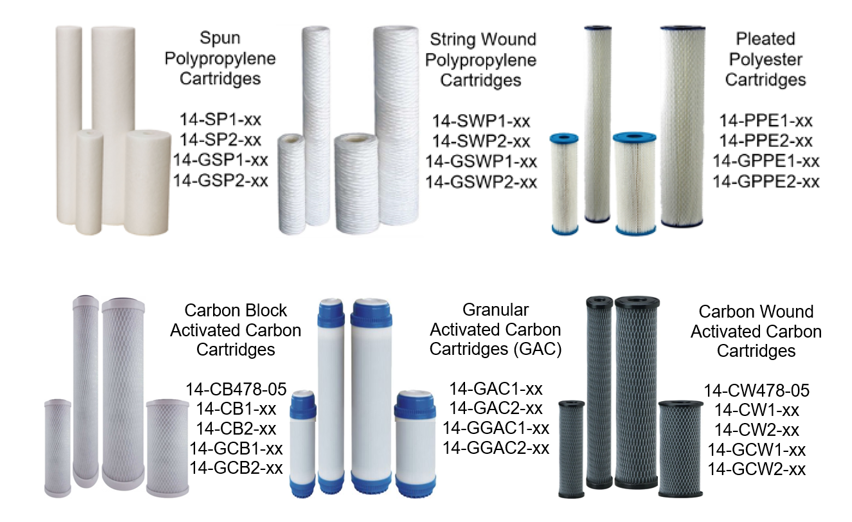
Common sediment cartridges:
- Spun Poly
- Pleated Polyester
- String Wound
(5–50 micron ratings)
All the above types of cartridges are effective at removing sediment. The selection often comes down to customer preference.
Larger housings (Standard 20" or Giant) are common to meet GPM requirements, though 10" may suffice for low-occupancy dwellings.
Adding Carbon to POE
When taste and odor problems exist at all faucets:
- Install second POE carbon filter plumbed in series.
- Sediment pre-filter removes the bulk of the particulate which increases the life expectancy of activated carbon cartridges.
- Carbon cartridges should last 4–6 months (depending on absorption load).
2. Point-of-Use (POU) Filtration
POU systems filter water at a specific faucet or appliance. Commonly installed in the cabinet under a kitchen sink to supply the drinking water faucet. Other POE applications would be to have one installed before an icemaker or a fridge with a water dispenser.
Common characteristics:
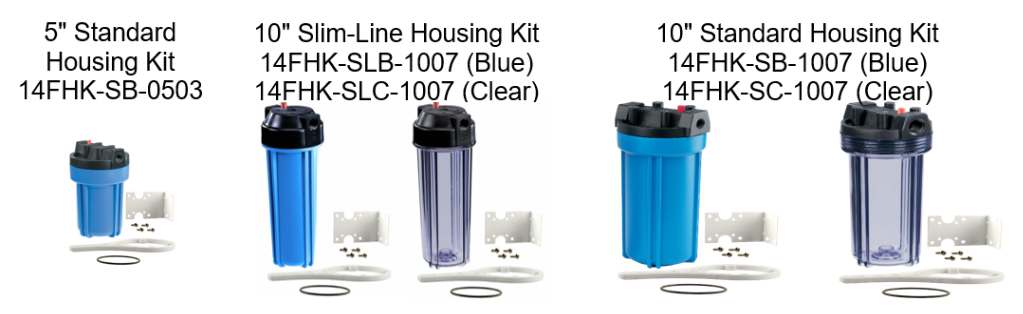
- Typically 10" standard housings
- Slim-Line kits ideal
- 5" housings used in RVs, camping trailers, boats
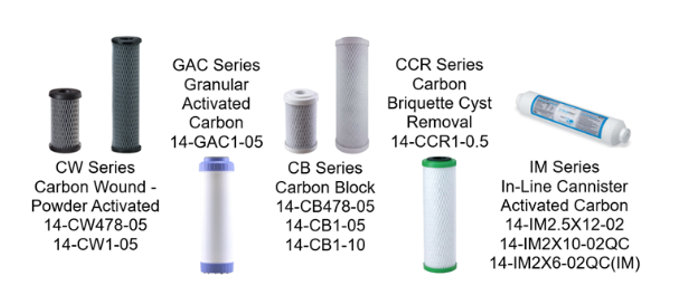
Common Cartridges:
- Carbon Briquette
- Carbon Block
- Granular Activated Carbon
- Carbon Wrap
POU systems are cost-effective because carbon cartridges are expensive. Filtering water that would go to outdoor wall hydrants for irrigation or washdown applications for taste and odor improvement is unnecessary.
POE Installation Locations
While Under-sink installation is common, precautions must be taken:
- Chemical exposure risks; Household cleaners and chemicals could adversely affect the plastic components of the filter and must not be stored in the same cabinet
- Limited servicing space; filter changeout can be more difficult to access
- Potential property damage from leaks
Preferred location:
- Basement utility room; access to filter for servicing and cartridge changeout is much easier than in a cabinet
- Near drain; reduces change of property damage
- Below or close to faucet; directly below a second floor faucet is ideal whenever possible
3. Pre and Post Filtration
Boshart offers sediment and carbon filters which are used as pre and post filters for water treatment systems such as Reverse Osmosis (RO) and Ultraviolet (UV). (Boshart does not offer the actual RO or UV water treatment systems.)
Reverse Osmosis (RO)
Pre-filters are used to protect the costly membrane (which Boshart does not carry):
- Sediment (1–5 micron) Spun Poly, String Wound or Pleated
- Note: Avoid the use of Pleated cartridges that contain cellulose
- Carbon (0.5–5 micron) Granular Activated Carbon & Carbon Block
Reverse osmosis (RO) filter systems typically have 3, 4, or 5 stages, with 4 or 5 stages being the most common for residential use to ensure high-quality drinking water.
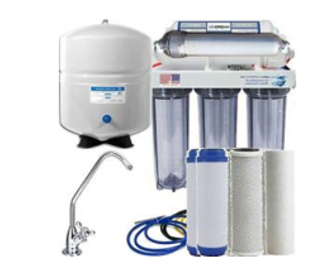 ** Photo: Typical RO filter system (not offered by Boshart).
Ultraviolet (UV)
Pre-filters are used to remove particulate down to at least 5-microns. A pre-filter cartridge filter is necessary before a UV light system to remove sediment and debris that can "shadow" or shield bacteria and pathogens from UV rays. Bacteria can hide behind particles of sand, rust, or debris larger than 5 microns. If shielded, these organisms can pass through the UV light without being harmed.
- Sediment (1–5 micron); Spun Poly, String Wound or Pleated
- Note: Avoid the use of Pleated cartridges that contain cellulose
- Activated Carbon (0.5–5 micron) to remove chlorine and eliminate undesirable taste and odors; Granular Activated Carbon & Carbon Block
Always follow manufacturer instructions when selecting the type and micron rating of the filter cartridges.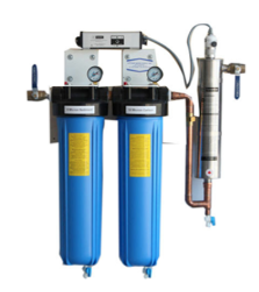
**Photo: Typical UV filter system (not offered by Boshart).
4. Special Applications
- High Temperature
- High Pressure
- Chemical Compatibility
Glass reinforced nylon High-temperature housings are suitable up to 164°F & 125 PSI. For higher temperatures use Stainless Steel housings which are suitable up to 300°F & 300 PSI. High temperature string wound cartridges are available in Natural (tin core) and Bleached cotton (stainless steel core) are both suitable up to 300°F.
Part 3: Identifying Your Filter Cartridge
To determine your existing cartridge:
Step 1 – Measure: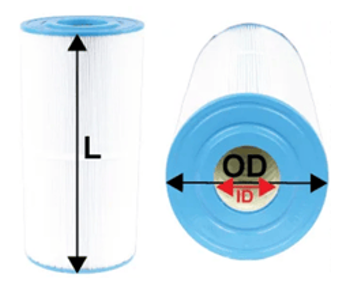
- Overall Length
- Outside Diameter (O.D.)
- Inside Diameter (I.D.)
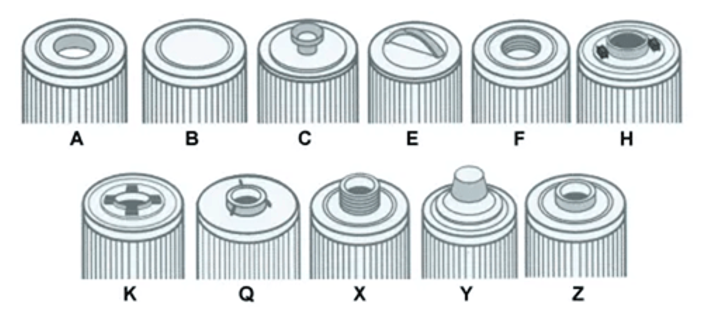
Step 2 – Identify End Type
Boshart carries:
- “A” Open End Type
Step 3 – Bottom End
If both ends are Type “A” → Double Open End (DOE)
If mixed ends → Single Open End (SOE) (must source from manufacturer)
Note: GAC cartridges may appear closed on bottom.
Step 4 – Check Core
- Spun Poly: No core
- Pleated & String Wound: Have core
- Core may be plastic, tin, or stainless
Step 5 – Identify Cartridge Type
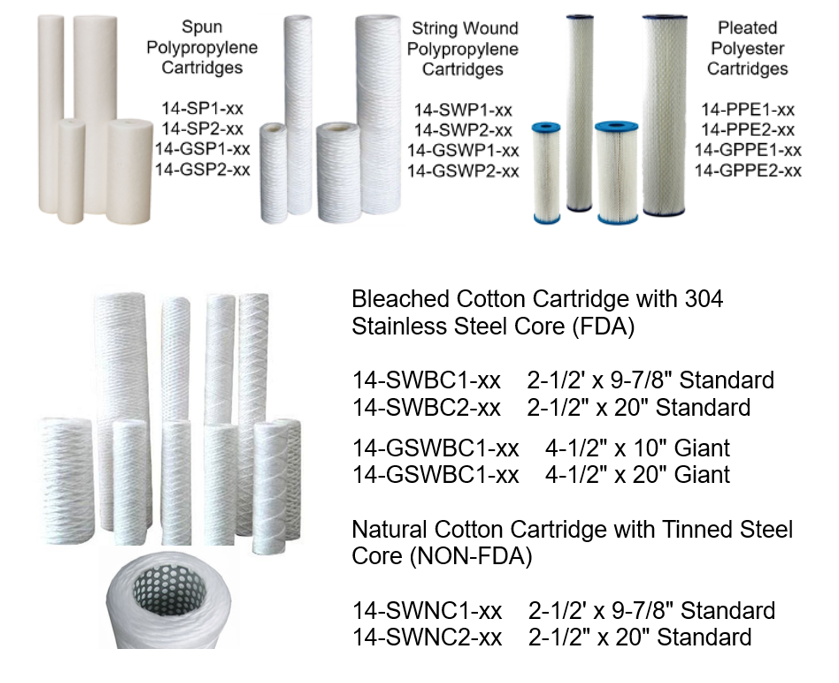
Sediment Cartridges:
Available in Standard 2-3/4” diameter & Giant 4-1/2” diameter in both 10” and 20” nominal lengths.
- Spun Poly (14-SP1, 14-SP2 & Giant 14-GSP1, 14-GSP2)
- Pleated Polyester (14-PPE1, 14-PPE2, & Giant 14-GPPE1, 14-GPPE2)
- String Wound; Poly Core (14-SWP1, 14-SWP2 & Giant 14-GSWP1, 14-GSWP2)
- High Temp Cotton (14-SWBC1, 14-SWBC2 & Giant 14-GSWBC1, 14-GSWBC2; 304SS core OR 14-SWNC1, 14-SWNC2; Tin Core)
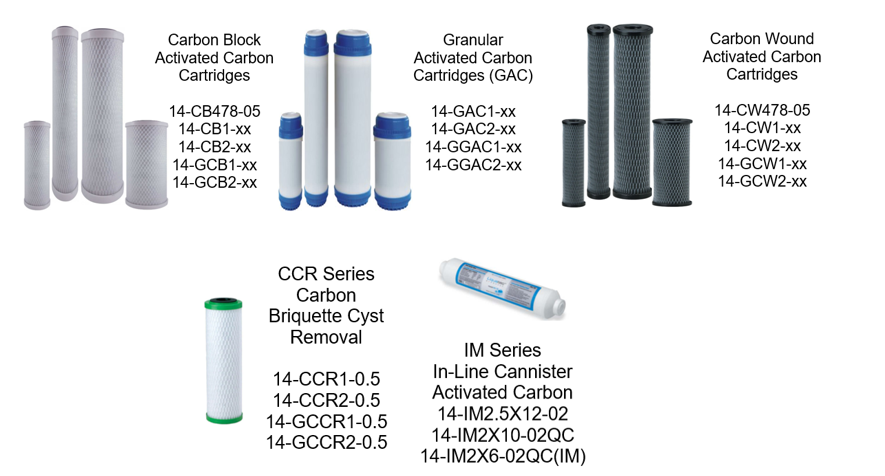
Activated Carbon Cartridges:
Available in Standard 2-3/4” diameter & Giant 4-1/2” diameter in both 10” and 20” nominal lengths.
-
- Carbon Block (14-CB1, 14-CB2 & Giant 14-GBC1, 14-GCB2 )
- Cyst Removal Carbon (14-CCR1, 14-CCR2 & Giant 14-GCCR1, 14-GCCR2)
- GAC (14-GAC1, 14-GAC2 & Giant 14-GGAC1, 14-GGAC2)
- Carbon Wrap (14-CW478, 14-CW1, 14-CW2 & Giant 14-GCW1, 14-GCW2)
- Must only be used with chlorinated water supplies
- In-Line Icemaker/Dispenser (14-IM)
Step 6 – Determine Micron Rating
This may be difficult and may require selecting a rating suitable for the application but not necessarily replacing with the same micron rating as the previous cartridge.
Final Tip:
Secure the cartridge label near the housing to simplify future replacements.
If uncertain, provide photos of:
- Housing (showing make/model)
- Cartridge beside tape measure
and send it to our sales department, and they will be better equipped to verify what you have.
Part 4: Traditional Sediment vs. Spin-Out Filters
Only used in POE systems when there is extreme particulate load. Both remove sediment—but function differently.
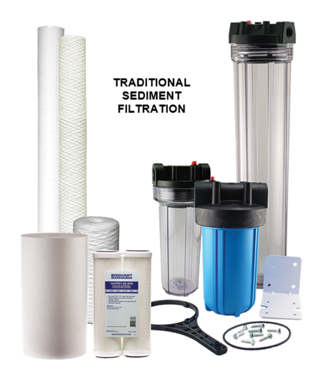
Traditional Sediment Filters
Types:
- Spun Poly
- Pleated
- String Wound
Best for:
- Light to Moderate sediment loads
Limitation:
Heavy sediment loads can clog a sediment cartridge before the six-month mandatory changeout, causing pressure drop and resulting in the need for premature cartridge replacement.
Spin-Out Sediment Filters & Separators
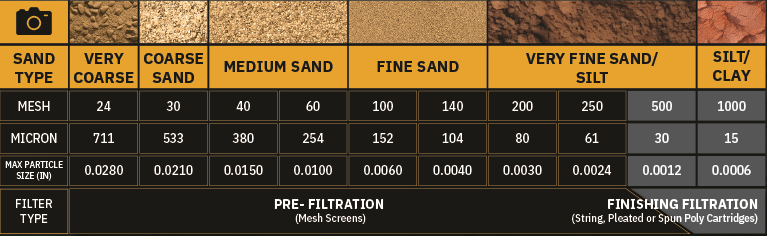
Spin-Out filters are pre-filters. The stainless steel mesh screens range from 24 mesh to 1000 mesh. 1000 mesh is the finest screen, limiting particulate removal down to 15 microns. To remove finer particulate traditional sediment filters must be used. Spin-Out filters use centrifugal force, the spinning action of the water, to separate heavy particulate.
Features:
- Reusable 316 SS mesh element can be rinsed and reinstalled
- Purge valve allows flushing of sediment while system is in operation
- Reduces premature clogging of sediment cartridges to achieve a 4-6 month changeout frequency reducing overall filtration costs
Ideal for:
- Water wells having heavy sediment loads
- Can be installed on the suction side of a pump, whereas traditional sediment filters cannot
- Pumping from Reservoir/lake/stream
- Note: Not recommended for use in applications where algae is present, algae will be drawn onto the surface of the screen impeding water flow
- Agriculture
- Watering Devices including but not limited too; Irrigation, Fogger/Misting Nozzles, Poultry Watering
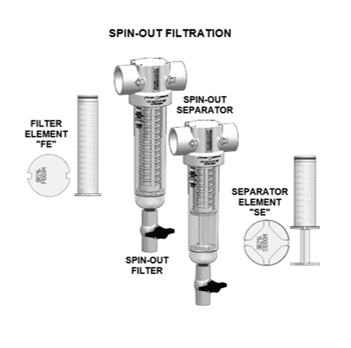
Often installed in series before traditional point-of-entry (POE) whole house sediment filters to extend cartridge life.
Spin-Out Filter vs. Spin-Out Separator
The difference between a filter and separator is that the separator has a reservoir to store large amounts of sediment that has been removed from the water. The sand in this reservoir is not spinning which reduces abrasion and prevents damage to the filter bowl.
A separator is used where there are extremely high loads of sediment. Spin-out sediment filters and spin-out separator filters both utilize stainless steel mesh filter elements which can be removed, rinsed off, and put back into use. They will reduce overall filtration costs and labor due to frequent cartridge change outs. They are ideal when heavy sediment loads are present in the water, typically from water wells which produce significant volumes of sediment and applications involving pumping from water reservoirs, lakes, and streams. The difference is the sediment collection chamber size.
- Spin-Out Filter: Smaller sediment collection chamber
- Spin-Out Separator: Larger chamber for extreme sediment loads
The separator’s larger chamber reduces turbulence and abrasion by isolating separated sediment.
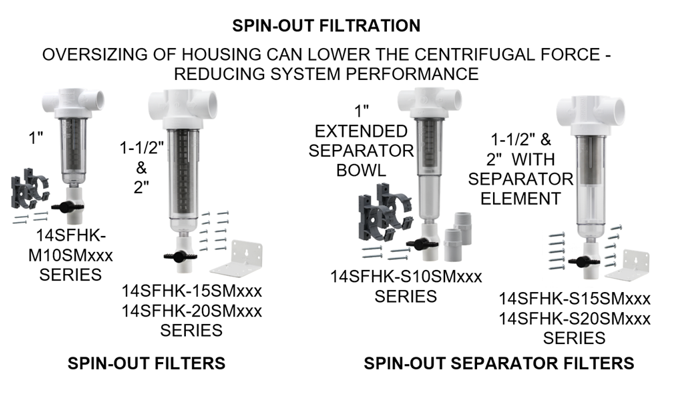
Spin-out filters are commonly installed in series with a traditional 10, 5 or lower micron rated sediment filter cartridge as a finishing filter. The spin-out filter has a purge valve which allows for quick and easy flushing of the sediment without disassembly.
Troubleshooting Common Filtration Issues
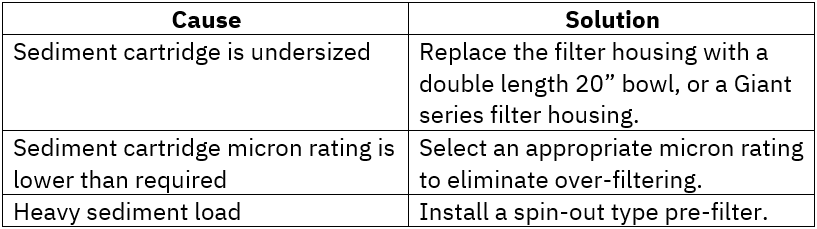
Problem: Premature Clogging of Sediment Cartridge before 6 month mandatory changeout
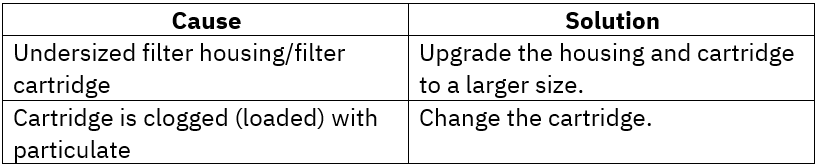
Problem: Low Water Flow/Pressure
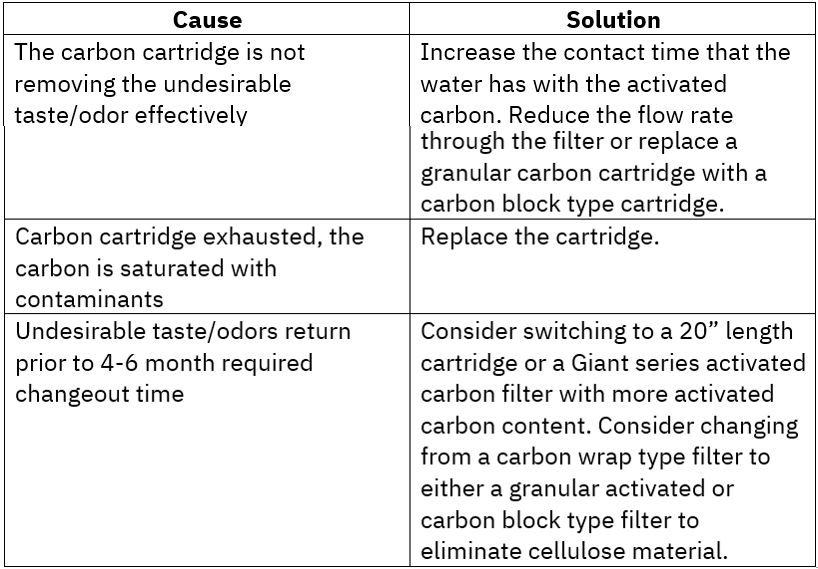
Problem: Undesirable Taste/Odor Persists or Reoccurs
Conclusion
Proper filter system selection depends on:
- Proper water testing
- Determine type of filter cartridge required
- Verify desired flow rate (GPM)
- Select a cartridge with 2-3 times the desired flow rate
- Select the housing size (Standard or Giant) to accommodate the cartridge selected
Understanding :
- differences between POE and POU systems
- differences between pre-filtration and post (finishing) filtration
- the difference between sediment removal and taste and odor reduction (carbon filtration)
- traditional vs spin-out filtration
When properly selected and maintained, a filtration system can deliver consistent water flow, improved appearance, and better taste and odor performance throughout the home.