
Q. What do I need to know in order to properly select a tank tee?
There are a number of factors to consider when selecting a tank tee or manifold for your application. The material, Stainless Steel vs Brass is an important decision to minimize the impact dezincification will have on your system.
You will need to confirm the following before ordering a tank tee or tank tee package:
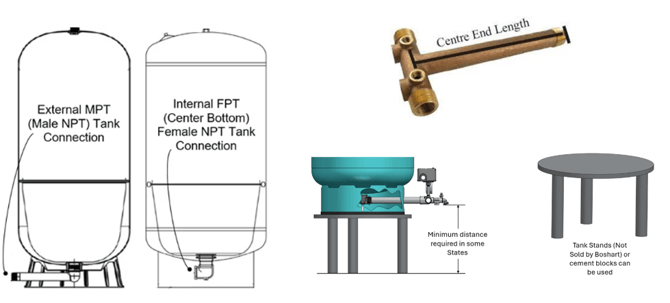
- Tank connection type and size
- Center bottom vs side connection, MPT vs FPT, Size (1” or 1-1/4” standard)
- Measurement from the tank connection to the outside diameter of the tank
- Plumbing and Well Construction codes
- Material of pressure tank’s acceptance fitting
Additional Resources:
What should I consider when selecting and installing a tank tee?
What do I need to know about my pressure tank before ordering a tank tee or tank tee package?
Q. What is the best practice for installing tank tees.
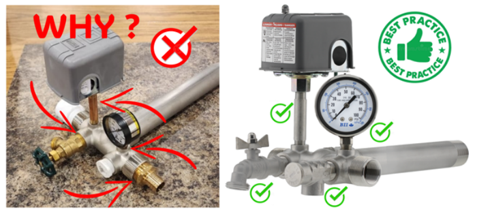
When installing BRASS tank tees, best practice is the plumb the connection using the external threads of tee (line connection) vs in the internal threads, to minimize the risk of stress cracking the tee.
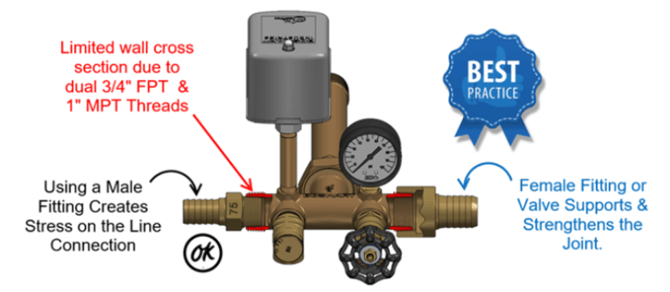
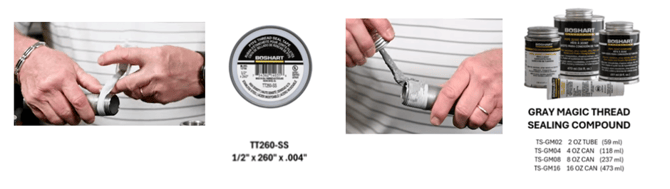
When installing 304 Stainless Steel tank tees, best practice is to plumb the connection using the external threads of the tee (line connection) vs the internal threads, to minimize the risk of stress cracking. However; due to the significantly higher strength of Stainless Steel castings, it is not as critical to use female fittings when installing Stainless Steel tank tees. Also, best practice when installing a 304 Stainless Steel tank tee includes the use of P.T.F.E tape (TT260-SS series) along with a thread sealing compound like Gray Magic (TS-GM series).
Additional Resources:
What is the best practice for installing tank tees?
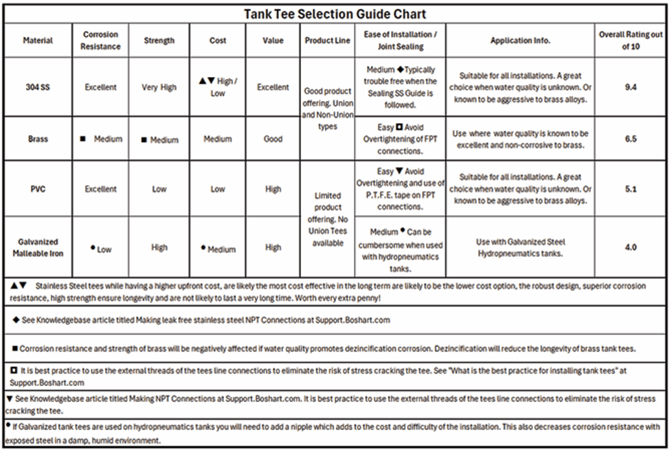
Q. Does the material of the tank tee determine the material of the components you connect it with? Should a SS tank tee use all ss components and a brass tank tee use all brass components?
Yes, although the risk of galvanic corrosion in minimal, it is always best practice to avoid joining dissimilar metals.
A material selection guide is available as part of each of the tank tee and & manifold technical data booklets:
Additional Resources:
Constant Pressure Manifold Booklet
Is there any concern regarding 304SS and Copper being in contact?
Q. Does the orientation of the plumbing to and from a tank tee need to be in any particular order for water flow direction? Do the pressure gauge, pressure switch, drain valve and pressure reducing valve components need to be installed in a particular accessory port?
There are various tank tees designed to fit a wide range of pressure tank brands, each offering different connection sizes and types. There are no critical rules that must be followed as to which accessory gets installed on the right vs. the left-hand accessory ports. However, the upward and front facing accessory ports are threaded in a way so that certain accessories will only fit in the orientation they are meant for.
“Flow direction” is also irrelevant; it does not matter which direction the water flow, left-to-right or right-to-left. The water flow can be plumbed in either direction.
Additional Resources:
Tank Tee Installation – Three Plumbing Options
Q. Do you supply replacement O-rings for Union Tank Tees?
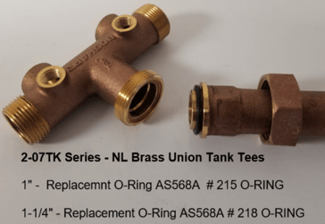
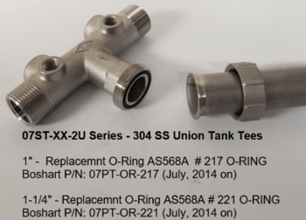
Yes! The 07ST-xx-2U Series Stainless Steel Union Tank Tees are designed with AS568 North American Standard O-Rings. Replacement O-Rings can be readily purchased online or at most local hardware or industrial supply houses to avoid costing shipping and handling. Boshart also carries the O-Rings for these tank tees.
Additional Resources:
Replacement O-Rings for 07ST-xx-2U, 07ST-xxS & 07ST-xxSF Series 304 S.S. Union Tank Tees
The O-ring standard sizes and part numbers for all tank tees can also be found in the tank tee technical data booklet: 07ST-07TKO-Brass-SS-Tank-Tee-Data-Sheet-V4.pdf
Q. Do you have replacement “Teflon” flat washers for the older style union tank tees?
Yes, although we do not use the term "TEFLON" as it is an infringement on a registered trademark of Dupont. For this reason, we refer to the washers as P.T.F.E., which stands for the actual material name polytetrafluoroethylene.
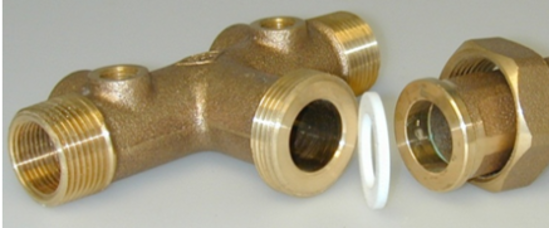
The part numbers are 07PT-TW-10 (1” tees) and 07PT-TW-12 (1-1/4” tees). The transition from the P.T.F.E. washers to the current O-Ring seal occurred back in 2014.
Additional Resources:
For compatible models of tank tees and more information on P.T.F.E washers for older style Union Tank Tees, and the reason behind the change to an O-ring, click here.
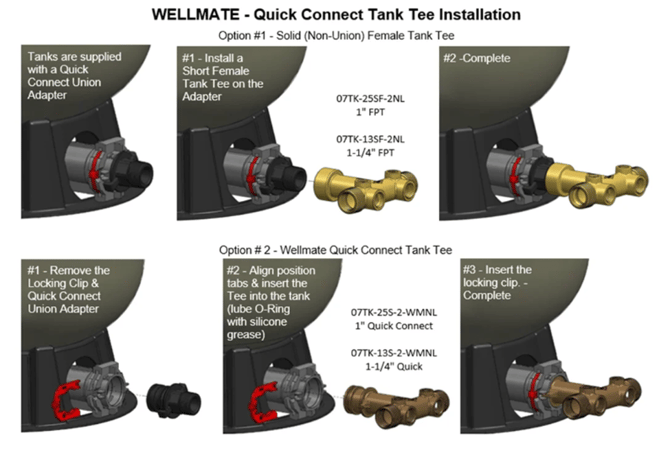
Q. Do you have installation instructions for the WELLMATE (WM Series) Quick Connect Tank Tees?
Yes, the installation instructions for Wellmate Quick Connect Tank Tees can be found here.
Q. How do I measure to get the Correct Center end length of a tank tee?
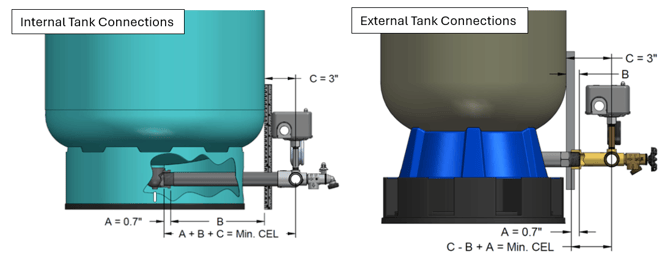
Overall length of the tank tee is not a relevant measurement. It is critical that the “C”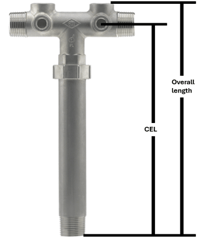 dimension of 3” as detailed in the diagram below is maintained so that the pressure switch has sufficient room to rotate without hitting the tank when the switch requires change out. Failure to keep this dimension will result in extensive labor if the pressure switch fails.
Additional Resources:
For more detailed instructions on determining the minimum Tank Tee CEL (center end length) required click here, and see step #3.
You can also find the Centre-End Length for each tank tee in the tank tee technical data booklet: 07ST-07TKO-Brass-SS-Tank-Tee-Data-Sheet-V4.pdf
Q. What is the maximum working pressure and temperature of tank tees?
The maximum pressure rating is 200 PSI. The tank tees are designed for cold water applications and have a maximum temperature rating of 100° F (37.7 °C). This applies to both No-Lead Brass and 304 SS non-union (solid) tanks and union tank tees, as well as No Lead Brass and 304 SS Constant Pressure manifolds.
NEVER EXCEED THE MAXIMUM OPERATING PRESSURE & TEMPERATURE RATINGS OF THE PRESSURE TANK. For that information reach out to tank manufacturer. If you have a pump system that exceeds the maximum flow capacities of the tank, an option is to use multiple pre-charged pressure tanks manifolded together using standard pipe fittings and nipples.
Additional Resources:
What is the maximum working pressure and temperature of tank tees?
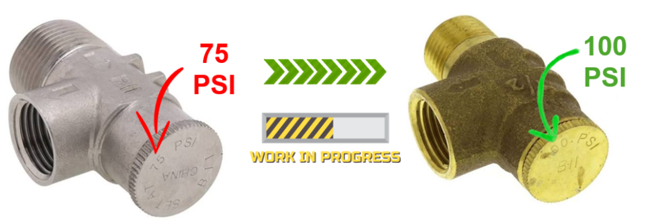
Q. Why are we offering all tank fitting packages with a 40-60 pressure switch to include a 100 PSI relief valve?
This main reason behind this upcoming change is to prevent nuisance blow offs, the unwanted opening of the relief valve when not desired.
Economy relief valves RVNB and SSRVN series are factory set at either 75 PSI or 100 PSI. They have a plus / minus tolerance of 15% which must be considered when selecting the pressure switch setting of a tank fitting package (20-40, 30-50, 40-60 or 60-80), which may also have a small margin of error. If the blow off pressure is too close to the maximum system pressure, the risk of a nuisance blow off increases. For example; A 75 PSI relief valve could go off at 63.75 PSI (75 PSI less 15%) and a 40-60 may shut off at 63 PSI leaving very little margin of error.
Boshart feels it is in the best interest of our customers to have a greater safety factor (buffer). We suggest a 10% safety factor by installing a 100 PSI relief valve that can open between 85.0 to 115.0 PSI a safety factor of approximately 29.73%.is achieved.
Q. Which series of Tank Tee provides the most value for the money?
304 Stainless Steel tank tees provide the best value for the money, due to their high corrosion resistance and superior strength. In our opinion, the best choice of tank tee is a Stainless Steel Union Tank Tee, followed by a close second – a Stainless Steel Non-Union (solid) Tank Tee.
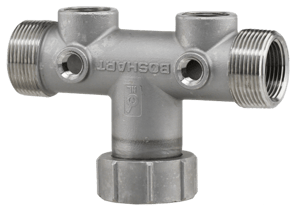
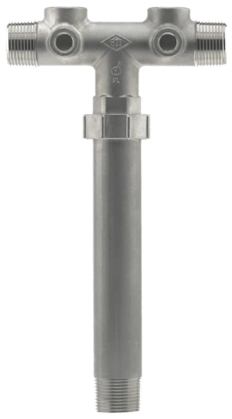
While Union tank tees have a slightly higher up-front cost that non-union (solid) tank tees, union tank tees will save you money in the long term on labour costs when your pressure tank needs to be replaced.
Additional Resources:
Why choose a union tank tee vs a non-union (solid) tank tee?
Q. What determines when we need a 1” vs 1-1/4” size? Is this solely flow rate related?
The size of the tank tee need is primarily determined by the connection size on the tank. Usually, the connection size of the pressure tank is related to the flow. Larger volume tanks typically have 1-1/4” size. For tank tee size selection, match the tank tee’s tank connection to the pressure tank acceptance fitting size.
Additional Resources:
How to select the proper size of tank tee or constant pressure manifold.
Flow Coefficient (Cv) for the 17YBCVxxxNL, 17CVxxxNL & 17CVSS-xxx Series Check Valves.
Q: Does Boshart offer Constant Pressure Manifold fitting packages?
Yes, Boshart offers a wide range of constant pressure manifold fitting packages. The manifold packages are available in brass and 304 stainless steel. They come in a wide range of sizes and with a wide range of components to fit any application. Several variations are catalogued.
Custom fitting packages are also available.
Additional Resources:
Does Boshart have constant pressure manifold fitting packages?
Q: What is the most common problem encountered when installing a new tank tee?
The most common problem has nothing to do with the tank tee itself; the problem is that it is very common that a new pressure switch and/or pressure tank is being installed at the same time.
The required differential between the pressure switch’s cut-in setting and the tank’s pre-charge pressure is insufficient. This causes the pressure system to malfunction with the system’s pressure bottoming out to zero before the pump starts. Boshart recommends an absolute minimum of 10% difference, or a 15 – 20% difference is ideal to avoid system malfunctions.