
From time to time there will be an issue getting a seal when replacing the filter bowl after a filter cartridge change out, no doubt when this occurs it is very frustrating.
In most cases the leak can be stopped by following these steps. Following this procedure has proven to be highly successful in sealing a nuisance leak.
#1 - Check for old filter cartridge gaskets, laying in the bottom of the filter bowl. 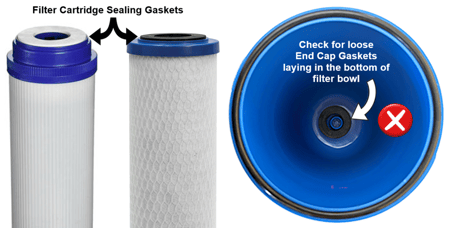
Filter cartridges such as Activated Carbon Cartridges (GAC Granular A.C.) and CB (Carbon Block A.C.) have rubber gaskets (black, white, or translucent in color). The gaskets are required on hard/ rigid plastic filter cartridge end caps to ensure a positive seal to prevent bypass of unfiltered water around the top and bottom of the cartridge which need to be sealed against the seat in the filter head and filter bowl.
If one of these gaskets comes off the cartridge and remains in bottom of the filter bowl and a new filter cartridge is inserted, the length is increased, which will not allow the filter bowl to be threaded in far enough to fully compress the filter bowl O-ring against the seal in the filter head (body) and it will result in a leak.
While this would appear to be an obvious problem, it is all too often overlooked and ends up being the problem which is the last thing that gets considered; for this reason it is the best place to start.
#2 - Depressurize the system and remove the bowl. TIP: Make sure to have a basin below to catch any water that may spill when removing the bowl.
#3 – Remove the O-ring from the groove in the clear or blue filter bowl, clean and inspect it for any signs of damage such as nicks, cuts, or flat spots. Make sure the O-ring is: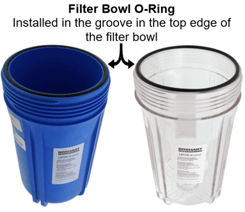
- Soft and Pliable
- The right size- both diameter and cross section
- Has not been stretched.
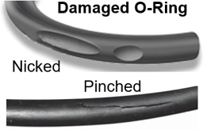 If your O-ring has dried out over time, shows any signs of cracks or other damage, or has been stretched and no longer fits properly into the housing groove, it is time to replace it. You can find replacement seals based on the filter housing kit model number.
#4 - Clean the filter bowl groove thoroughly. The tiniest specks of sand, dirt, or silt can prevent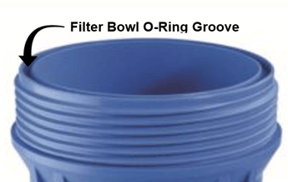 an O-ring from sitting flat against the filter cap resulting in a slow drip or a significant leak when pressurized.
#5 - Verify the O-ring is the correct size. One of the most common causes of a leak, second to a damaged O-ring that results in a leak, is that the O-ring is not the right size. An O-ring that is designed for a different brand of housing may look very close to the same size but may have slight dimensional differences.
#6 - Apply a thin layer of NSF/ANSI-61 certified silicone grease (Part Number: OR-LUBE) to the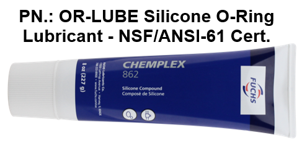 O-Ring seal. WARNING: Never use petroleum-based jellies (like Vaseline) on an O-ring, as they will cause the rubber to swell and or degrade.
#7 - Install the O-ring into the groove. Ensure it is seated properly in its groove.
O-Ring Fit in Groove
A) - The filter bowl O-ring should lay flat in the groove. It should not have to be stretched or forced into the groove.
B) - The O-ring should protrude above the filter bowl by approximately 1/16". If the O-ring disappears below the top edge of the filter bowl the O-ring has too small a cross section, and it will be impossible to seal the filter bowl.

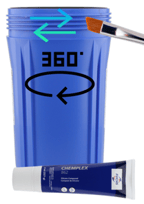 #8 - Apply a thin layer of NSF/ANSI-61 certified silicone grease to the thread on the filter bowl to reduce friction.
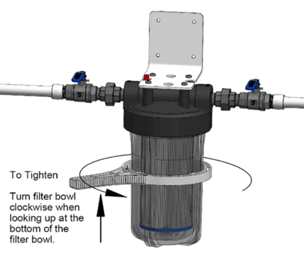
#9 - Hand-Tighten; thread the bowl into the filter head carefully by hand. Cross-threading is easy and can crack the housing components or deform the O-ring seal.
Then finish tightening the bowl using a wrench 1/8 (45°) to 1/4 (90°) turn. If you still have a slow drip further tighten using the filter wrench to give it an extra 5° to 10° degrees of clockwise rotation until the leak stops.
WARNING: Do not overtighten, too often excessive torque is applied. Too much torque can potentially pinch or distort the O-ring and lead to leaks.
#10 – Re-pressurize the system. If you have a slow drip further tighten the filter bowl in small increments using the filter wrench until the drip stops.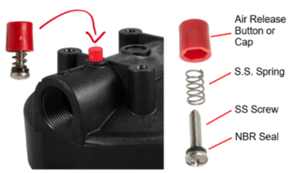
Additional Information:
Air Release Button: If your filter head has a red pressure-relief button and is dripping, sand, silt or other foreign debris might have become trapped in the seal. Press the button a few times while the system is under pressure to flush out debris or unscrew and clean it if it continues to leak.
https://support.boshart.com/water-is-dripping-from-the-red-button-on-my-water-filter
https://support.boshart.com/how-to-install-a-water-filter-air-release-button