Flow Velocity is the key factor to take into consideration when selecting the proper size tank tee or constant pressure manifold. 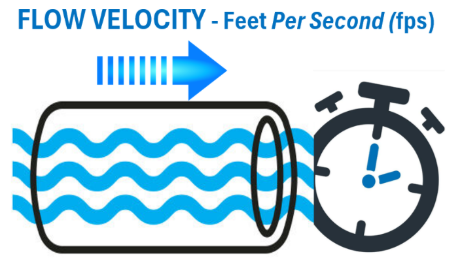
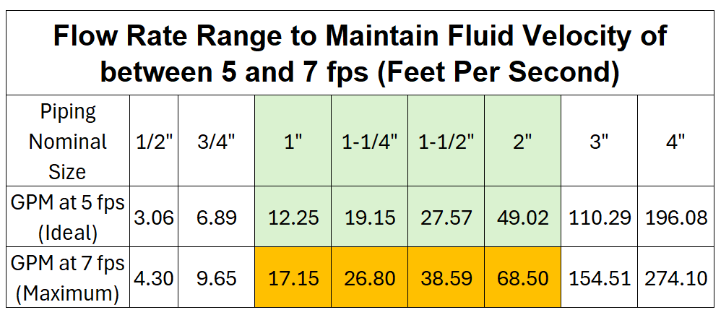
Larger pipe is more expensive, however keeping the water velocity low is important to limit pressure losses due to friction, water hammer, and pipe movement due to water momentum changes inside the pipe. It is recommended to size piping to maintain a water velocity of 5 ft/second (1.524 LPM).
Five feet per second is a threshold that is widely accepted by engineers and designers because beyond this velocity, the friction losses, danger of water hammer, and pipe movement due to water momentum changes are deemed to be too high.
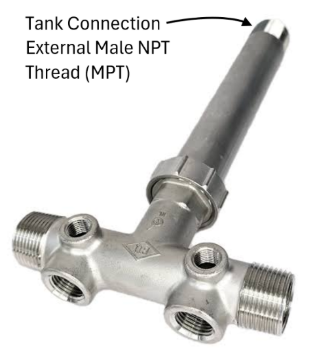 For tank tee size selection:
Simply match the tank tee’s tank connection to the pressure tank acceptance fitting size. The tanks are normally manufactured with either a 1” or a 1-1/4” connection.
- Smaller pre-charged pressure tanks with a capacity in the range of 20 - 32 gallons typically have a 1” tank connection.
- While larger pre-charged pressure tanks with a gallon capacity in the range of 34 to 120 gallons typically have 1-1/4” tank connections.
For manifolds size selection:
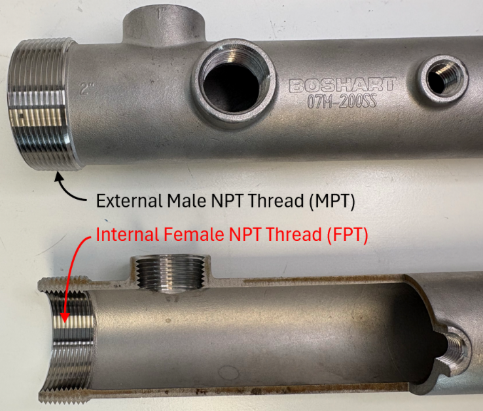 Simply select a manifold large enough to ensure the piping used will maintain a suitable flow velocity. The piping size can be altered by using the internal (FPT) connections or the larger external (MPT) connections.
Rule of Thumb
- 1” Tank Tees are suitable for 5 to 15 GPM pumps
- 1-1/4” Tank Tees are suitable for 10 to 23 GPM pumps
- 1-1/4” Manifolds are suitable for 5 to 23 GPM pumps (Using the internal 1” FPT connections)
- 2” Manifolds are suitable for 10 to 32 GPM pumps (Using the internal 1-1/2” FPT connections/ piping)
- 2” Manifolds are suitable for 20 to 60 GPM pumps (Using the external 2” FPT connections / piping)
This will keep flow velocity in the suitable range, refer to the chart below.