
Part One: Material Selection Chart
Q: What are the Pros and Cons of various materials used for plumbing fittings and valves?
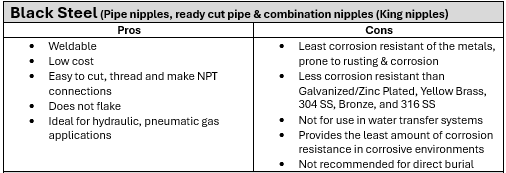
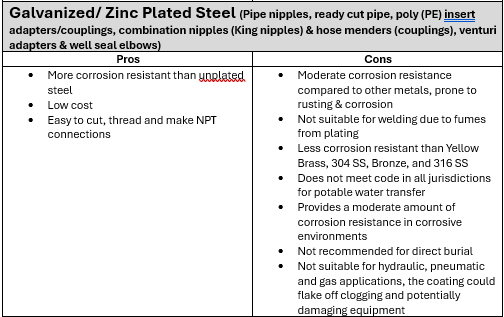
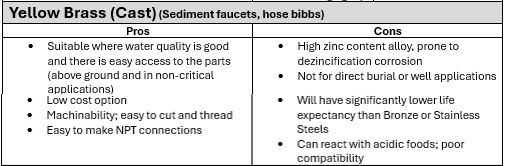
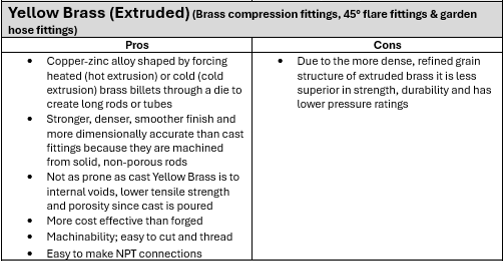
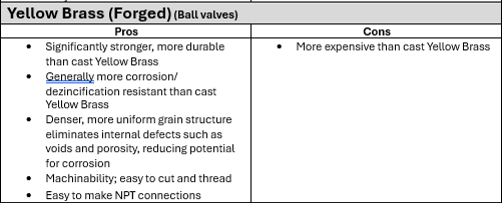
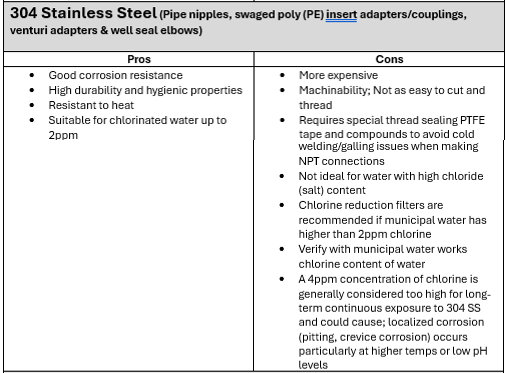
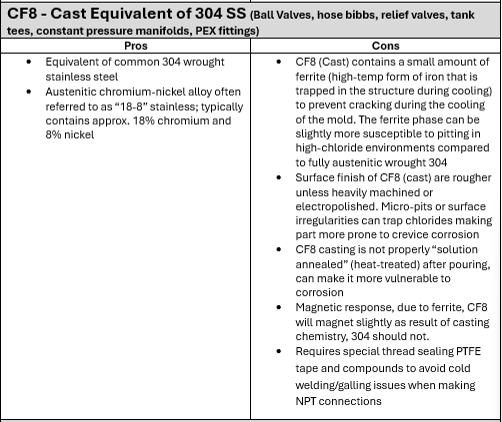
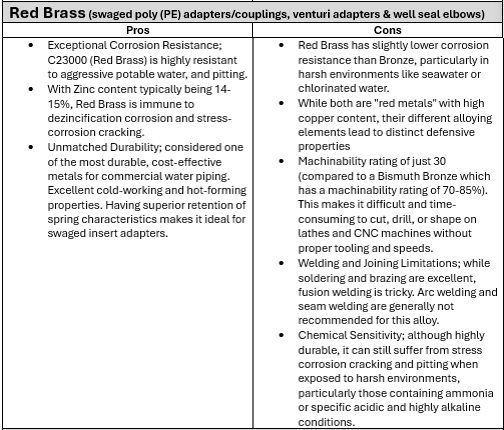
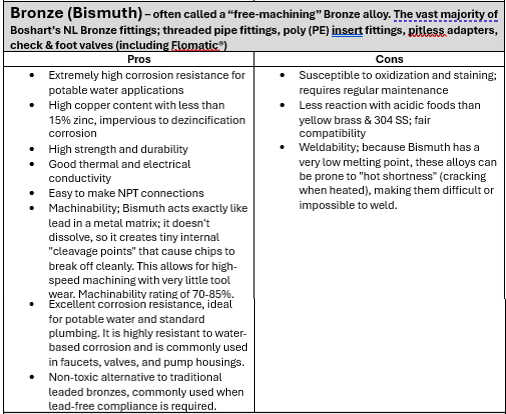
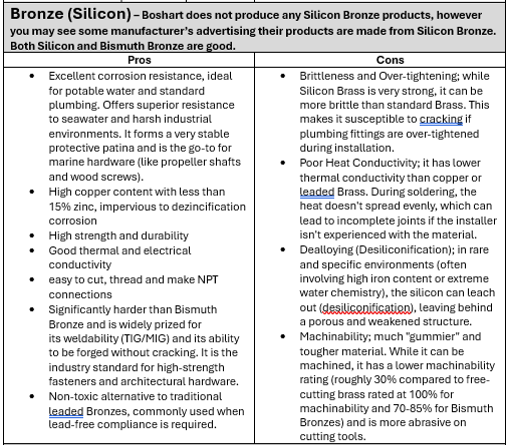
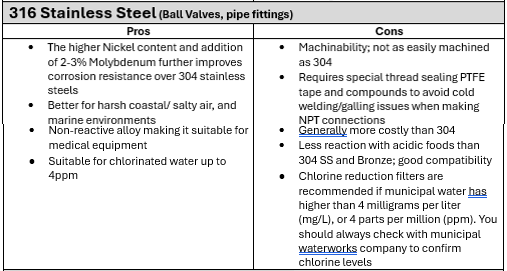
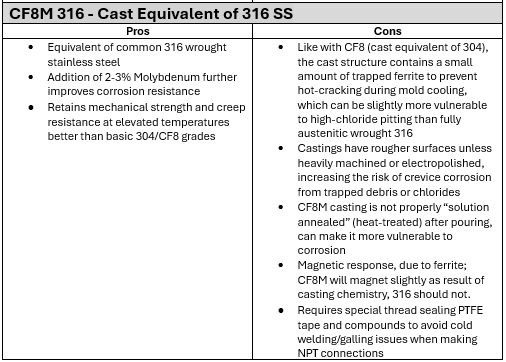
Part Two: Stainless Steel vs Brass & Bronze - Frequently Asked Questions:
Q: Can Stainless Steel and Brass or Bronze fittings be mixed?
A: If you must join brass or copper to stainless steel the galvanic corrosion will be insignificant as the alloys are so close. Although the risk of galvanic corrosion is minimal, it is always best to avoid joining dissimilar metals directly together whenever possible.
Examples Where Brass or Copper and Steel or Stainless Steel Have Been Joined Directly Without Any Notable Issues:
#1 – Brass to Galvanized Pipe: Brass gate and ball valves are commonly joined directly to galvanized pipes.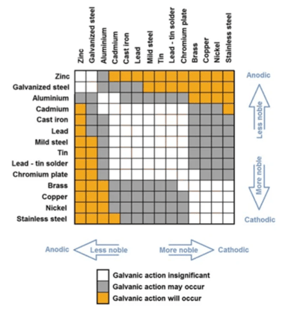
#2 - Frost-Free Yard Hydrants use this combination of dissimilar metals (Brass/Bronze Valve Bodies & Galvanized Pipe).
OF NOTE: Boshart has developed a new and improved YHSS series yard hydrant that has a 304SS valve body, standpipe, connecting rod, and coupling to provide a high level of corrosion resistance.
#3 – Boshart Push-Fit fittings use a S.S. gripper ring that is in direct contact with copper pipe. NOTE: While the S.S. gripper ring is not in direct contact with the water, it is often exposed to moisture resulting from condensation inside the fitting due to the cold water running through the piping.
#4 - Submersible pump manufacturers were using S.S. tubing for the wet end of the pump with brass or bronze end fittings without any notable corrosion problems over the course of many years.
For more detailed information on joining dissimilar metals click here.
For more detailed information on 304SS and Copper being in contact click here.
Q: Are Stainless Steel and Brass suitable for direct burial?
A: Brass alloys with more than 15% zinc content (yellow brasses) are subject to dezincification and are not recommended for direct burial. This type of corrosion can weaken the brass fitting. Metals that are more resistant to dezincification such as bronze, red brass, or stainless steel are preferred.
304 S.S. is a much better choice than brass for underground installations. However, in aggressive soils they too can be adversely affected by the soils aggressive conditions, therefore 304 S.S. components must be wrapped with a silicone pipe wrap to protect against accelerated corrosion by the soil. Failure to wrap the fitting in any underground application will void the warranty if the failure is soil related.
For more detailed information on suitable materials for direct burial click here.
For more detailed information on using BOSHART Brass and SS Push-Fit fittings underground click here.
Q: What applications are ideal for 304 SS and 316 SS?
A: 304 and 316 are the most popular grades of stainless steel. Depending on the application, each of them are intended for different uses.
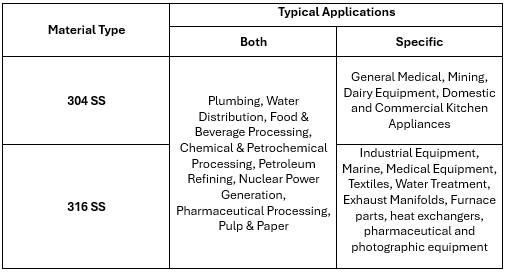
For a more detailed list of 304 & 316 Stainless Steel applications click here.
For more detailed information on 304 & 316 Stainless Steel in food grade applications click here.
Q: What is the difference between 304 and 316?
Both 304 and 316 stainless steels are good for corrosion resistance, however due to differences in the alloy composition, 316 stainless gets the slight edge in all categories including corrosion resistance, strength, welding, and heat resistance. With regards to the chemical composition of the alloys, the main difference between the two is the addition of Molybdenum in grade 316. While grade 304 may have trace quantities of Molybdenum, this element exists in a higher percentage (2% to 3%) in 316. When Molybdenum is added it significantly improves the corrosion resistance properties of an austenitic stainless steel alloy. 316 is significantly better than 304 for handling chlorides.
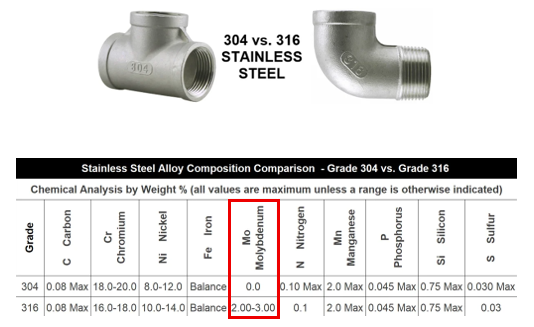
For more information on the difference between 304 & 316 Stainless Steel click here.
The main difference between the Light Pattern ISO 4144 and Heavy Pattern MSS SP-114 fittings is in their wall thickness and weight. Light pattern fittings are generally lighter in weight and have a thinner wall thickness. They are more suitable for potable water systems and light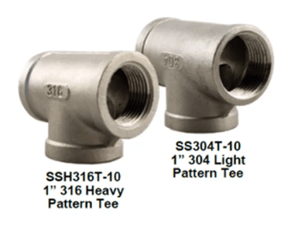 commercial applications where pressure and temperature requirements are not extreme. Heavy pattern fittings have thicker walls and provide more durability, making them an excellent choice for industrial applications that are operating at the higher end of the temperature and pressure ratings. Furthermore, MSS SP-114 fittings were designed based on malleable iron fittings for wall thickness, and have controlled lay lengths making them the fitting of choice for factory maintenance.
When it comes to choosing between light and heavy patterns based on pressure and temperature requirements for your application, the heavy pattern is often overkill unless you need dimensional stability, if the system needs to be replaced. Light pattern is typically for water system plumbing.
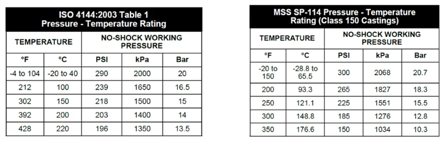
For more information on Light vs. Heavy Pattern Stainless Steel Fittings click here.
Q. What is dezincification and what accelerates this happening?
Dezincification is a form of corrosion and weakening of brass objects in which zinc is dissolved out of the brass alloy. Zinc leaches from the copper alloys in an aqueous solution. This leaves behind a porous and copper-rich structure that has reduced mechanical strength. Brasses containing more than 15% Zinc, often referred to as yellow brasses, are susceptible to dezincification and are not suitable for direct burial.
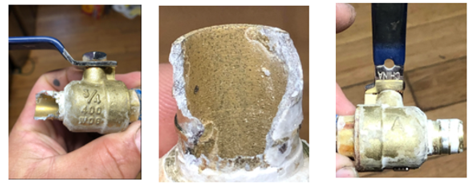
For more information on dezincification and what accelerates this happening click here.
For more detailed information on Brass alloy C46500 & dezincification resistance click here.
Additional Resources:
Review of Brass Dezincification Corrosion in Potable Wate...
Dezincification of faucets with different brass alloys - ScienceDirect
Q: Why do Brass Ball valves turn green?
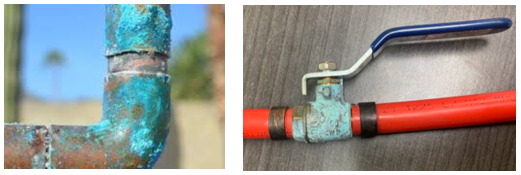
A green, crusty, or powdery buildup on a brass ball valve is verdigris, a greenish-blue patina formed when the copper inside the brass oxidizes due to moisture, air, and sometimes acidic conditions. Can be found on copper pipes and brass ball valves.
Greenish corrosion should not be confused with dezincification; it is oxidization of the copper and not as serious as dezincification.
This is the natural oxidation process of copper, which is accelerated by exposure to moisture and corrosive elements. By implementing preventative measures such as protective coating, regular cleaning, and proper storage, you can maintain the appearance and performance of brass fittings in your plumbing systems.
Additional Resources:
Why do brass fittings turn green - Knowledge - Fengfan Piping
Q: Which metal is best for hard water applications?
Hard water contains dissolved minerals, particularly calcium and magnesium, which can negatively impact plumbing fixtures.
- Stainless steel Fittings - Less prone to corrosion and mineral deposits which can build up and reduce flow. Less likely to succumb to effects of freezing environments as it is less apt to crack. Greater longevity, pricier but warranty could make higher cost a better long term investment.
- Brass Fittings - Hard water can penetrate protective coating and corrode brass fixtures. Mineral deposits can reduce water flow and potentially damage seals and washers. Can develop a surface coating of chalky lime scale mixed with a patina (green coating) leading to a change in colour/ appearance.
Q: What is the key difference between Yellow Brass & Bronze?
Over 400 different copper and copper-alloy compositions exist. They are broadly categorized into groups like brass, bronze, copper-nickel, and high-copper alloys. These groups are then further divided into specific alloy types; it is important to know the exact alloy of the material you’re working with.
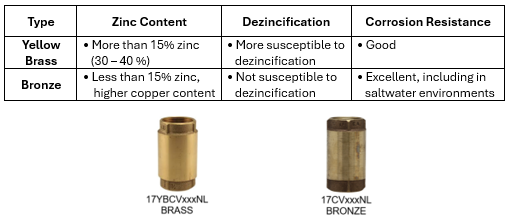
For more information on Brass vs Bronze alloys click here.
Additional Resources:
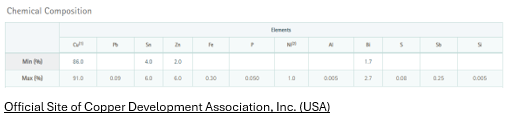
What is the Chemical Composition of C46500 Brass Alloy?
Metal Failure Expert Discusses Failure Analysis of Brass Plumbing | Read Consulting
DZR (Dezincification Resistant) brass is designed to highly resist dezincification, not to be completely immune to it. While it vastly outperforms standard brass in aggressive water, it is designed for long-term resistance, particularly in plumbing, rather than total, universal immunity under all possible, extremely corrosive conditions. While it is engineered to withstand aggressive water environments, it can still experience slow, long-term corrosion, over the course of anywhere from 20 – 50 years.
DZR alloys usually have higher copper content and lower zinc than standard brass and are enhanced with arsenic, typically in the 0.02 – 0.15% range, to inhibit corrosion. DZR brass increases the anti-corrosive properties, but this does not mean they are immune to dezincification entirely.
Although potable water is unlikely to cause dezincification, it is capable! NSF approved Lead Free DZR alloys are available on the market. Where distribution systems might introduce water conditions or fluids that may be more prone to cause dezincification, you should use Dezincification Resistant Brass fittings and valves at minimum. However, the selection of a more suitable bronze or stainless-steel product may be required to prevent failure due to dezincification.
Q. Are Red Brass and Bronze the same thing?
Both are copper based alloys and share some similarities but have different primary elements. Red brass, also known as gunmetal, is a specific type of bronze that contains copper, tin, and zinc. Bronze, more broadly, is an alloy of copper and tin, but can also include other elements like zinc.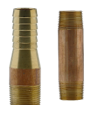
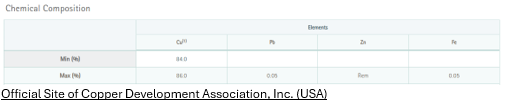
Red Brass – Typically used for pipe, pipe nipples and swaged insert fittings. This is an alloy of copper and zinc.
C23000: Red Brass alloy specifications (ex. BRN-0145)
Bronze – Typically used for casting, most common NL bronze alloy can be found in Boshart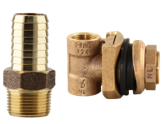 pitless adapters and insert adapters. This is an alloy of copper and tin.
C89844: NL Bronze alloy specifications (ex. PA-100NL).
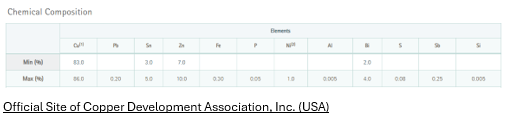
C89833: NL Bronze alloy specifications (ex. Boshart Bronze Insert Adapters).
Q: What is Carbon Steel and how is that different from Stainless Steel?
As the name suggests, carbon steel contains a higher concentration of carbon—up to 2.5%—compared to other types of steel. Standard carbon steel does not contain nickel or chromium. The main difference between Carbon steel and Stainless steel is the material composition.
Carbon steel is primarily iron and carbon, while stainless steel contains at least 10.5% chromium. This chromium content in stainless steel forms a protective layer that prevents rust and corrosion, making it more durable in various environments. Carbon steel, lacking this protective layer, is more susceptible to rust and corrosion when exposed to moisture or other corrosive elements.
For more information on Boshart Carbon Steel pipe nipples click here.
Q: Can Stainless Steel fittings be used in R/O Systems
Stainless steels are well suited to the requirement on RO as their resistance to aqueous corrosion is high. Since SS is resistant to corrosion it helps prevent metal ions from leaching into the water, which could contaminate or cause scale build up on RO membranes
Unfortunately, some stainless steels are prone to pitting and crevice corrosion in certain waters – notably those containing chlorides.
- Special care is required because chlorides can attack SS and cause localized corrosion or pitting
- Selecting the proper SS grade helps reduce this risk and prevent damage to the RO system components and membrane
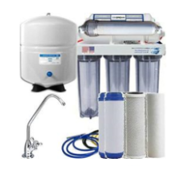
*Photo is of a typical RO system which Boshart does not carry.
Q: What materials are best suited for chlorinated drinking water?
In order of best to worst suitability, Bronze provides good compatibility, 304 & 316 Stainless Steels provide fair compatibility, and Yellow Brass would be a poor choice for compatible material in a chlorinated drinking water application.
Chemical Compatibility Database from Cole-Parmer
Chlorine content in your tap water poses no immediate threat to your health, however over a long period of time, one could experience potentially harmful effects such as; asthma symptoms, food allergies, bladder and rectal cancer and also just the unpleasant taste and smell of the water.
The use of a carbon filter in a whole-house filtration system can remove chorine from your home’s water and prevent these side effects.
Chlorine in Drinking Water: What Are the Effects?
Most Canadian tap water has an acceptable level of chlorine which is typically between 0.04 to 2.0 mg/L. To minimize your risk when drinking water does not meet municipal guidelines, activated carbon filters are an excellent choice to remove chlorine and it’s by products. Installing a Chlorine reduction system to get levels down to 2ppm or less will protect your plumbing fittings and more importantly, your health.
It's Your Health: Drinking Water Chlorination
Q: Can Banded Stainless Steel Fittings be welded?
Yes, our 304 & 316 SS threaded fittings can be welded, as well as our machined couplings.
In regard to weldability of Stainless Steels:
- Lower carbon Stainless steels (304L or 316L) offer better weldability and higher corrosion resistance after welding and do not require any post-weld heat treatment or annealing
- The lower carbon material prevents carbide precipitation during welding – which means less chromium being depleted near the weld = better corrosion resistance.
Boshart does not carry any low carbon stainless steel fittings (304L or 316L). 304 offers higher mechanical strength making it a better choice for structural application.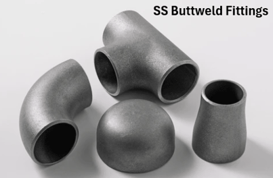
(Socket or buttweld SS fittings are typically 304L or 316L, but Boshart does not carry any. These types of fittings are used in applications where the transition must be as smooth as possible and no crevices for media to settle; ex. dairy industry.)
Q: What are some common myths about Stainless Steel?
Here are some common myths about Stainless Steel.
1. “Stainless Steel is non-magnetic”
Type 300 Stainless Steel (referred to as austenitic grades) are confusingly referred to as “non-magnetic” alloys, in their raw material form they are in fact non-magnetic. However, when this material is worked, bent, deep drawn, formed into tube or pipe it can become magnetic. Even when it is cut, the deformation in the edge of the metal can cause magnetism.
The rise in magnetism is directly related to an increase in tensile strength and work hardening caused by the heat and friction of cold forming. It does not reduce the corrosion resistance or cause any molecular change in the austenitic raw material.
The strength of the magnetism depends on how much the metal has been deformed.
Corrosion resistance depends entirely on the percentage of chromium, nickel and (sometimes) molybdenum that is in the stainless steel.
Higher contents of chromium, nickel and molybdenum result in increased corrosion resistance (ex. Type 316 SS). Cast austenitic grades are more likely to crack in the casting process if they aren’t formulated to be somewhat magnetic – the same applies to welds.
So, castings are usually magnetic, unless they have been heat treated.
Magnet testing to confirm alloy can be very misleading, for a true evaluation of quality and corrosion resistance of Stainless Steel, an RXF alloy composition tester should be used to verify the percentages of Chromium, Nickel and in some alloys Molybdenum.
In the annealed condition austenitic stainless steel is indeed non-magnetic. It is after cold working that they can be attracted to a permanent magnet. Magnetism and corrosion resistance are not connected; corrosion resistance depends on how much chromium and (sometimes molybdenum) is in the stainless steel – the higher the better.
2. “Stainless Steel doesn’t rust”
While stainless steels resist corrosion better than many other metals, they are not immune to it. In stainless steels, which contain a minimum of 10.5% chromium, the chromium reacts with oxygen in the atmosphere to spontaneously form a very thin colourless protective layer of chromium oxides on the surface. This is referred to as a passive oxide layer which protects the steel from corrosion.
Certain chemicals, such as chloride ions, can break down this passive layer. Salt water, for example, since salt is sodium chloride, can attack this passive layer. When the passive layer is breached it usually forms again spontaneously. In aggressive environments where there is a lot of salt in the air the passive layer may not be able to form, and some corrosion may take place. Corrosion will also occur in oxygen-deprived areas such as in screw threads, and under bolt head and gaskets; this is called crevice corrosion. Once the passive layer is gone, the steel can rust just like any other steel. Although this can cause stainless steels to look “rusty”, it will happen much more slowly than with most other metals, making it serviceable long after common engineered metal.
Often, when stainless steel appears to be rusting, it has actually been contaminated with carbon steel from cutting tools, jigs and fixtures which, of course the carbon causes rust, but the stainless steel gets the blame. If there is carbon steel contamination, treat the stainless with a passivating acid to remove the rust.